Vampire economics: some beginning thoughts
Or, yet another reason to worship the "Interview with the Vampire" TV series: financial planning

Someday soon I’ll stop watching AMC’s Anne Rice’s Interview with the Vampire series on AMC+.
But today is not that day.
Since this post will be about money, heads up: The first season is also viewable on Netflix, and for FREE on Hoopla, the digital library app, in the U.S. My well-funded local library offers me access to digital platforms Hoopla, Kanopy (sort of if Netflix, Britbox, and Criterion had a baby and had a secret drawer of indie films from all over the place), and Libby (e-books and audio). You can also get access if you belong to certain universities. Google it! Check it out! Get that library card! Support your library.
Okay, various spoilers will abound about the show, and less about the book, so if you don’t like that, log off and go watch my sexy, intersectional, operatic vampire show which also (spoiler alert) includes a choice insult about Jeff Bezos and thoughts about Flaubert’s style. And then come back.
So what I’d like to begin to talk about is how a fearlessly over-the-top show like IWTV pulls off some of its magic: by staying grounded in the cash dollars that make up this dirty world.
Money, honey: the book
Anyhoo. In the book Interview with the Vampire by Anne Rice, Louis de Pointe du Lac is a white Creole man in 1791 living outside New Orleans. Louis owns a plantation and is an enslaver. So many things to be written about that, but mostly: yikes.
Eventually, Lestat de Lioncourt, a French vampire, comes courting. Lestat wants Louis. Lestat also wants his land. (Update: apparently this is what LOUIS thought in the first book. In later books, we will learn that Lestat is actually rich as hell, and wanted Louis for Louis.
Money, honey: the series
In the series, Louis is a Black Creole man in the 1910s who has saved his family from bankruptcy by shifting their funds from a failing sugar plantation to brothels. He is a successful businessman, but racism is effing everywhere. His family, very Catholic, pretty proper, looks the other way. White men tolerate Louis, and he gets by with gritted teeth. Lestat empathizes, but as a white FRENCH (this comes up a couple of times) man from a previous century, he cannot really understand the wounds of racism Louis suffers. Lestat turns Louis, and urges him to leave the human world behind. Nope. Louis, frustrated by his world’s limitations, wants to open up a fancy club of his own. Lestat doesn’t quite get it. Still, Louis is his heart, and he loans his beloved the money to make it happen.
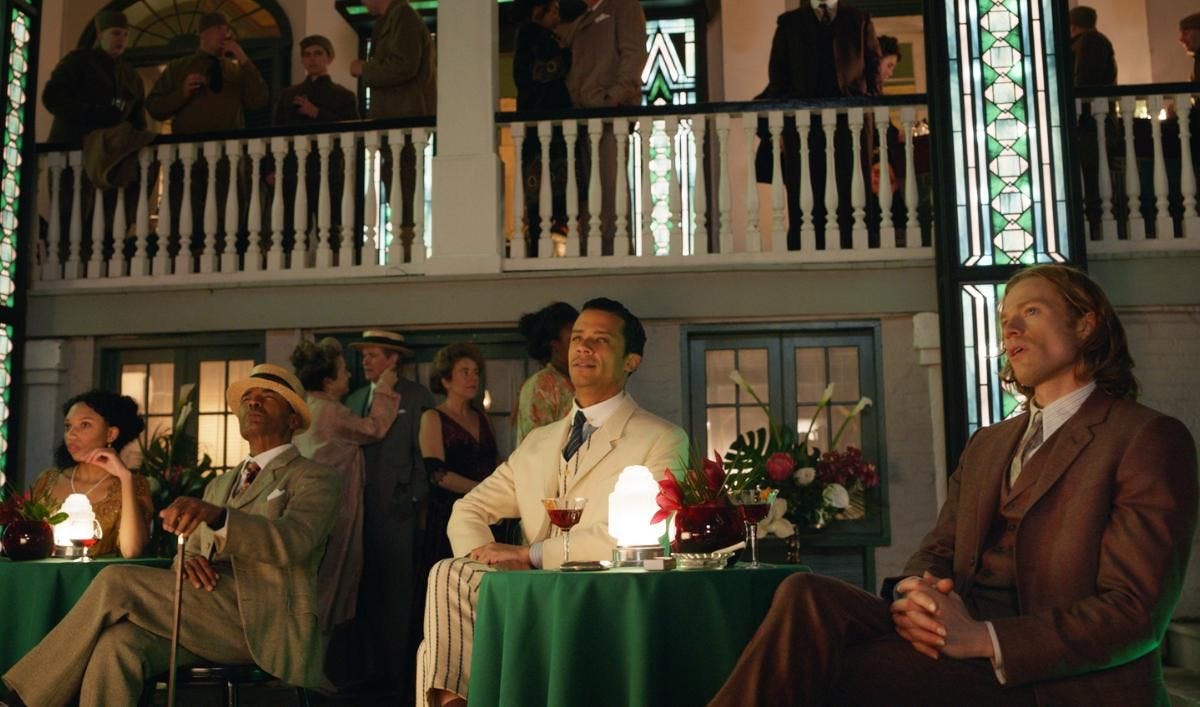
Louis gets his club. Lestat doesn’t get it. But he’s lovestruck.
Interview with the Vampire/AMC photos
And Louis pays back every cent, which he tells us (and his interviewer, Daniel Molloy) in voiceover.
That is probably when I fell in love with the show, forever and ever. This high-flying deeply romantic and kinky show, is GROUNDED IN DETAILS. Decades after Louis opened his club, he is desperate to tell us that he was as honest a businessman as he could be. Even with his gorgeous bananas vampire boyfriend. Maybe especially? In a world where your boyfriend is an immortal who could [redacted] a [redacted] in a Catholic Church—and does—you pay your debts.
More on Louis’ profit-sharing plan with his staff…next time.